

Snow fences are used by transportation agencies across much of the United States, particularly in regions prone to heavy snowfall and strong winds. They are widely deployed throughout the snow belt, including the Northern Plains, Upper Midwest, Mountain West, Northeast, and parts of the Pacific Northwest, where blowing and drifting snow routinely impact roadway safety and winter maintenance costs. Field experience and research show that properly placed snow fences can reduce snow drifting on roadways by 50 to 80 percent, significantly improving visibility, reducing crash risk, and decreasing the need for repeated plowing and deicing operations.
The safety benefits of snow fences are well documented. Research evaluating snow fence installations along Interstate 80 in Wyoming found that, during adverse winter conditions, fenced roadway segments experienced approximately a 25 percent reduction in total crashes and a 62 percent reduction in fatal and injury crashes compared to unfenced segments. These findings highlight the role snow fences play not only in improving maintenance efficiency but also in protecting drivers during the most dangerous winter weather events.
Studies and state DOT experience show that snow fences can deliver significant returns on investment by reducing fuel use, labor hours, and material application, with some agencies reporting savings of multiple dollars for every dollar invested. When properly designed and placed, often about 35 times the fence height upwind of the roadway, snow fences provide meaningful safety, operational, and environmental benefits for both agencies and drivers. For more information and a deeper look at the science and strategy behind snow fences, watch this video on snow fences.
National Updates & Insights
Snow, slick road conditions forces heavy traffic delays through Parleys Canyon
2KUTV | Jan 5, 2026
Overnight rain, followed by dropping temperatures, left roads icy, causing multiple crashes and significant delays on I-80 through Parleys Canyon and on SR-224 in Park City. The Utah Department of Transportation issued traction restrictions, with eastbound I-80 backed up more than 10 miles after several crashes and a stuck semi-truck near Parleys Summit; restrictions were later lifted eastbound but remained westbound. Similar crashes on SR-224 prompted the use of traction devices, while UDOT warned that high-elevation routes would remain slick until temperatures rose and crews finished clearing roads.
WYDOT reports 97 Wyoming snowplows hit in last five winters
Cowboy State Daily | Jan 5, 2026
Despite relatively mild winters, Wyoming continues to see elevated vehicle–snowplow crashes, with 97 plows struck over the past five winters, according to WYDOT. During the 2024–25 winter, 15 snowplow collisions were recorded—better than the 25 crashes during the severe “Snowmageddon” winter of 2022–23, but still well above the single-digit averages seen before 2019. WYDOT leaders told lawmakers that snowplowing is inherently dangerous work and emphasized the need for competitive pay and staffing to reduce fatigue and turnover. The agency is experimenting with green warning lights to improve visibility and adjusting its recruitment strategies, including targeting farmers and ranchers. WYDOT currently has 36 vacant highway maintenance positions (about 10%), mostly in rural areas, and supports a proposed 10.8% wage adjustment to improve recruitment and retention.
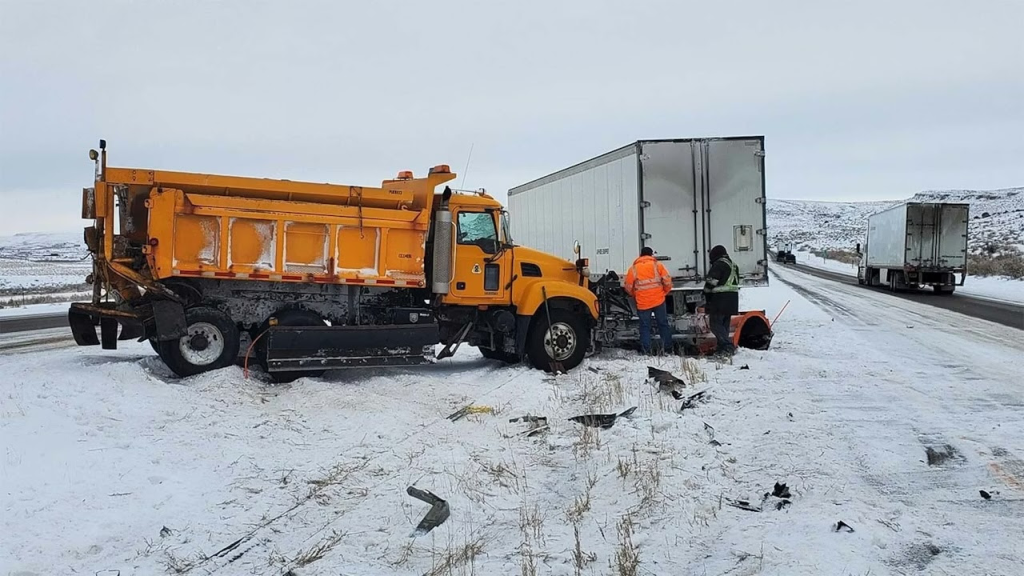
One state’s drivers urged to keep 200 ft from snowplows — Don’t drive too closely or face $100 fines
The Pulse | Jan 2, 2026
Michigan has enacted a new snowplow safety law requiring drivers to stay at least 200 feet behind operating snowplows (and about 20 feet when stopped at intersections), with violations carrying fines of roughly $100. Signed in July by Gretchen Whitmer, the law aims to reduce plow-related crashes, which rose to nearly 20 incidents per year in recent seasons. Officials note that snowplows can weigh up to 30 tons and create dense “snow clouds” that severely limit visibility, making close following especially dangerous. Sponsored by Sam Singh, the measure is supported by guidance from the Michigan State Police and Michigan Department of Transportation, which urge drivers to leave ample space, obey Move Over laws, and avoid passing on the right. Similar rules exist elsewhere, including Wisconsin, underscoring a broader push to protect snowplow operators and motorists during winter driving.
Local highway crews have secret weapon to treat roads this winter
7 NEWS | Dec 30, 2025
Highway crews in Adams, New York, are improving winter road safety by using an enhanced salt treatment called Magic Minus Zero, designed to perform in colder temperatures. The mixture includes molasses, which gives the salt a sweet smell and helps it stick to the roadway, reducing scatter from wind and making treatments last longer. Officials say the additive keeps snow looser and easier to plow, improving overall efficiency and safety. The neighboring town of Hounsfield has adopted the same method after seeing positive results. Drivers who notice a sweet scent on winter roads may be smelling the treatment helping prevent winter crashes.
How cold is too cold for road salt to be effective
MSN | Dec 30, 2025
When snow is forecast, roads are often pretreated with salt because salt works best before ice forms, not after. According to the New York State Department of Transportation, rock salt becomes less effective below 25°F, works slowly near 20°F, and is largely ineffective below 15°F, requiring much more material for diminishing results. To reduce environmental impact, the state promotes its “Don’t Be Salty, New York” campaign and expanded salt-management efforts that lower salt use through education and alternatives like brine. The New York State Department of Environmental Conservation encourages practices such as shoveling first, avoiding overuse, evenly spreading salt, and using brine solutions to save money and reduce pollution.
FACT CHECK: This article is partially correct—rock salt (sodium chloride) does lose effectiveness as temperatures fall and becomes slow and largely impractical below about 15°F under real-world conditions because it cannot form brine efficiently. However, not all road salts are the same: calcium chloride remains effective down to approximately –20°F to –25°F because it releases heat as it dissolves, magnesium chloride performs better than rock salt below 15°F and can remain effective to around –10°F or colder, especially when used as a liquid or pre-treatment, and many state DOTs rely on engineered blends and brines specifically designed for cold-weather performance rather than plain rock salt alone.
Stay connected
Follow NCFOR to stay connected with the latest updates, insights, and resources that support safer, more reliable winter travel across the country. Your feedback and story submissions help us spotlight the trends and challenges that matter most and strengthen the nationwide network of professionals dedicated to keeping America’s roads open and safe all winter long.


